In This Issue
Sandys Doesn’t Bluff
Field Notes • The Honest Shorebreak
Everybody’s got a beach that humbled them. Sandys humbles people for a living.
The numbers aren’t a vibe, they’re a ledger. Honolulu lifeguards pulled roughly 2,500 people out of the water at Sandy Beach between 2020 and 2022 — about two and a half rescues a day, the most of any beach on Oʻahu. Crowded Waikīkī logged 963 in 2022. And the visitors keep coming — up 63% in a decade, past half a million a year.
Here’s the part that should make you breathe before you paddle out: a 2019 study in the Hawaiʻi Journal of Health & Social Welfare found waves are the second-leading cause of spinal cord injury in the islands — 28% of them, 323 cases from 2009 to 2017. Ninety-eight percent were neck injuries. Eighty-five percent were visitors. Most happened in under three feet of water.
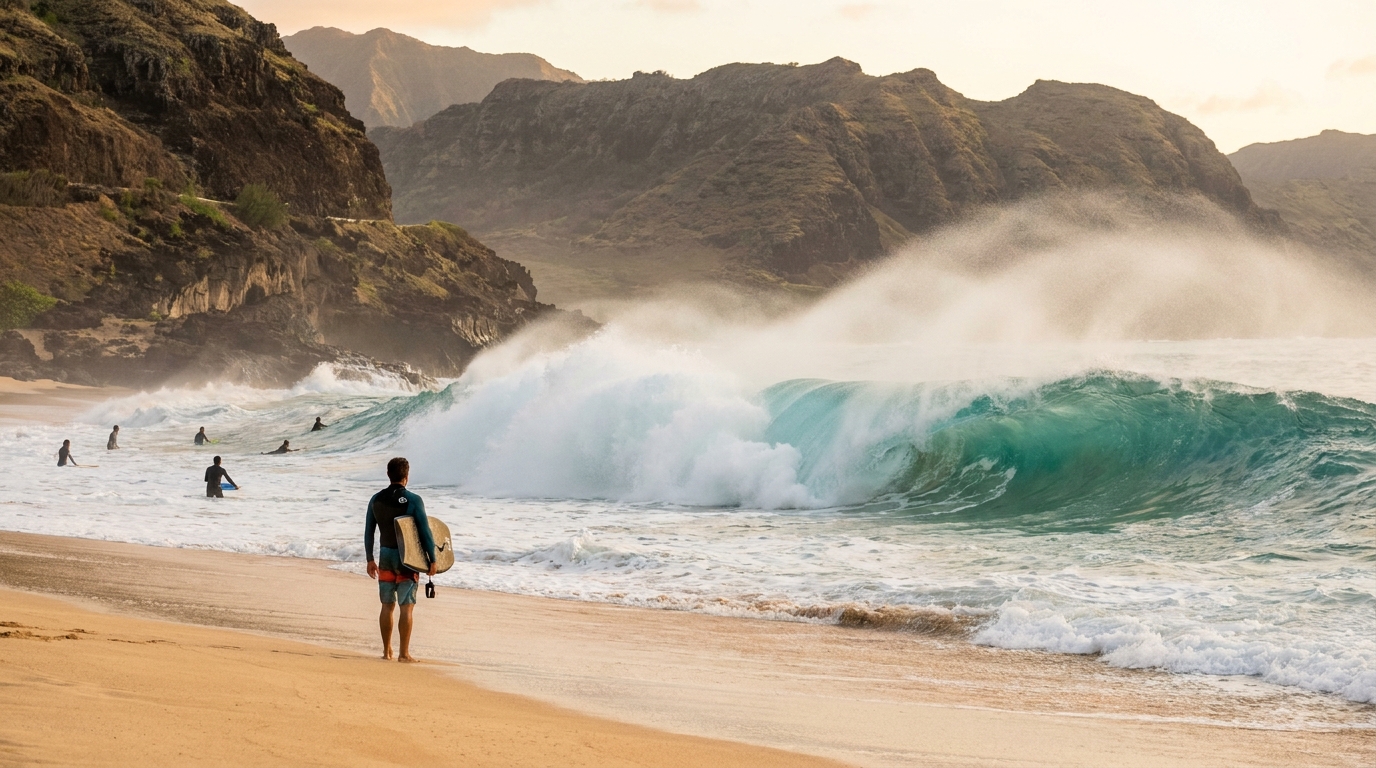
Three feet. That’s the whole trick, and it isn’t mystical — it’s geometry. The sand face drops steep, so the swell doesn’t unload gradually over a flat bottom. It stands up and detonates right at the shoreline, onto hard-packed sand, then drags the backwash out to reload. The wave doesn’t break in front of you. It breaks on you.
They don’t call it “Broke Neck Beach” to be cute.
I’m not telling you to stay out. I’m telling you the sand keeps honest books and doesn’t grade on a curve. The lifeguards there treat nearly every rescue as a possible spinal — board and collar — because they learned the hard way. One of them put it about as plain as it gets: “Even on the safest day, it is experts only.”
Pay your respect at the water’s edge, watch a few sets all the way through, and know which wave is yours before you trust it with your spine.
One honest note, because we don’t do slop: Sandys is the worst on Oʻahu, but Hapuna and Mākena outrank it on some statewide injury lists, and the “most dangerous beach in America” line traces to lifeguard experience, not a national dataset.
The Machine Sees a Switch Coming
Tide Desk • Reading the ENSO
Right now the Pacific is sitting neutral — the machine reads the central-Pacific temperature patch about half a degree warm, nothing dramatic (NOAA Climate Prediction Center, 14 May 2026). But the same advisory flips on an El Niño Watch: 82% odds it builds this summer, 96% it’s running by the heart of next winter.
Here’s why a surfer should care. When El Niño settles in, the North Pacific storm track slides south and parks closer to us through January and February. That’s the loud part — bigger, more frequent northwest swell, better odds the Eddie-sized days actually show (NOAA Climate.gov).
It’s a trade, though, and the accountant always names a price. El Niño softens the trades — sometimes flips them westerly — dries the islands out, and historically loads the dice for Central Pacific hurricanes. The strong 2015 El Niño spun up a record sixteen tropical cyclones in our basin, three Category 4s churning at once on a single August day.
The last monster, 1997–98, gave us “Biggest Wednesday” — the morning the Eddie got called off because Waimea was too big and tow-in surfing was born out of necessity. The wave-height numbers from that day are surf-press legend, not buoy fact, so take the “eighty feet” with a grain of salt. The swell was real enough.
So: neutral today, but the machine’s already leaning into winter. If the odds hold, start tuning the bigger boards and keep half an eye on the hurricane bulletins. The window that’s coming is the kind that doesn’t repeat for years.
Brown Water Math
Field Notes • After the Kona Low
A Kona low is the islands’ off-season sucker punch — an upper-level low that pinches off the jet stream northwest of us, loses its steering, and just sits there raining. No trades to push it along. The December 2021 one dumped over fourteen inches at one Big Island gauge and twenty-plus on Haleakalā’s south slope (NWS Honolulu).
All that water has to go somewhere, and on the way to the ocean it grabs everything. Hawaiʻi still runs around 88,000 cesspools leaking something like 52 million gallons of untreated waste a day. After a big rain, beaches near stream mouths test for staph and fecal bacteria many times higher than clean days — a UH Hilo study clocked levels 6 to 78 times up, MRSA included.
Then there’s lepto. Leptospirosis lives in fresh water and mud touched by animal urine, and it gets in through a cut, your eyes, your nose. Hawaiʻi runs among the highest rates in the country — roughly a hundred times the mainland — and about 45% of cases trace to recreational fresh water (CDC). It’s not a boogeyman; it’s a bacterium with a known address.
The state’s rule is plain: stay out 48 to 72 hours after the rain quits, until the water clears and the sun’s back on it. They post advisories, not closures — the call is yours.
So is it dangerous, or just gross? Honest answer: mostly the second, sometimes the first. Most healthy surfers paddle out in tea-colored water and never blink. But the exceedances are real, and the day you’ve got an open reef cut is the day the math turns against you. Brown water out front, fresh scrape on your knee — that’s when I sit it out. The wave comes back. A kidney you wreck on a hot lepto case does not.
The Channel Doesn’t Care
Field Notes • Go Home to Your People
This week the Coast Guard called off the search for a 61-year-old fisherman out of Waiʻanae. He left on a Wednesday in a 19-foot boat; his truck and trailer sat in the harbor lot. They found the boat partially sunk about eighteen miles offshore, searched nearly 179,000 square miles over 122 hours, and Monday night they stopped (Hawaii News Now). Somebody’s uncle didn’t come home.
It’s the kind of thing that makes you want numbers, so here they are. Nationwide in 2024 the Coast Guard logged 556 boating deaths — the fewest in fifty years. Drowning caused 76% of them. And of those who drowned, 87% weren’t wearing a life jacket (USCG Recreational Boating Statistics, 2024).
Read that again. The one thing that saves you is the thing most victims took off. Four of five deaths happen on boats under 21 feet — small boats, close to home, exactly the trip that feels too routine to gear up for. Alcohol is the top known factor.
Out here the water adds its own teeth. The ʻAlenuihāhā between the Big Island and Maui funnels the trades into one of the meanest channels on the planet, and the inter-island gaps don’t forgive a dead engine and a flat afternoon turning into a windy night.
None of the fix is mysterious. Wear the jacket. Clip the kill-switch lanyard to your leg. Leave a float plan with someone on land — where you’re going, when you’re back. Carry a VHF and a beacon. Boat sober. The ocean doesn’t grade effort; it grades preparation. Go home to your people.
Ahi Weather
From the Boat • The Summer Run
Summer is the ahi window. ‘Ahi means two fish here — bigeye, the deep sashimi tuna the longliners chase year-round, and yellowfin, the shibi that move in close through the warm months, roughly May into September with the heart of it June through August (Hawaiʻi Sea Grant).
Most of the local action happens on the buoys. The state has been hanging fish-aggregating devices since 1980 — today it’s a network of fifty-some FADs anchored 2 to 25 miles out, tended by the University’s marine lab (HIMB). Find a buoy holding bait and you’ve found ahi, mahi, ono — the whole summer pantry.
It all funnels to Pier 38. The Honolulu fish auction has run since 1952 and it’s the only fresh-tuna auction in the country — bidding starts around one in the morning, buyers thumbing tail-cuts under the lights. The Hawaiʻi longline fleet lands something like 30 million pounds a year, about $125 million at the dock, and 95% of all the bigeye landed in the United States.
There’s a quota on the prize fish — the bigeye limit ran 6,554 metric tons for 2024 under the western Pacific agreement (NOAA Fisheries) — because even the deep blue keeps books now.
But you don’t need the auction to feel it. The Fourth is coming, and in island kitchens that means fresh ahi — poke, seared, shoyu — the way it’s been done for generations. Gas up, check the buoy report, and go get your summer.